



Navigating Peptide Bioanalysis: Analytical Challenges and LC-MS/MS Solutions
-

Blogs
-

Jul 10, 2026
Why is Peptide Bioanalysis Critical in Drug Development
Peptide drugs, known for their strong target affinity and minimal side effects, have become one of the hotspots in new drug research. Compared to protein drugs, peptide drugs have simpler spatial structures and lower immunogenicity. They are widely used in medical fields such as vaccines, oncology, endocrine, and cardiovascular, etc., offering numerous advantages such as high specificity, potent bioactivity, remarkable efficacy, low therapeutic dosage, and less likelihood of developing drug resistance. However, they also have shortcomings such as short half-life, instability, susceptibility to degradation, and low oral absorption rate [1]. This section outlines the various challenges in peptide bioanalysis and proposes targeted strategies for peptide analysis.
Advantages of LC-MS/MS in Peptide Bioanalysis
Peptide drugs, offering numerous advantages, have emerged as a leading choice for drug development. Nevertheless, poor stability, prone to enzymatic degradation, and pH sensitivity present more challenges in peptide bioanalysis.
Common bioanalytical techniques for peptides mainly include Ligand Binding Assay (LBA) and Liquid Chromatography-tandem Mass Spectrometry (LC-MS/MS). Compared with LBA, LC-MS/MS offers the advantages of lower cost, highly specific at molecular level and have the capacity for multiple component analysis (Table 1), providing a significant advantage in peptide pharmacokinetics research.
Table 1. Comparison of LBA and LC-MS/MS [2]
Category | LBA | LC-MS/MS |
Basis of measurement | Biological binding reactions | Physicochemical properties of analyte |
Detection | Indirect | Direct |
Concentration response | Non-linear | Linear |
Standard curve range | Narrow range, ≤2 orders of magnitude | Wide range, ≥6 orders of magnitude |
Specificity | Comparatively less specific for discriminating drug from its metabolites | Highly specific at molecular level and have the capacity for multiple component analysis |
Sensitivity | Higher sensitivity | Comparatively less sensitive |
Recurring costs | Comparatively high | Low |
Challenges and Strategies in LC-MS/MS Analysis of Peptide Drugs
When using LC-MS/MS technology for peptide analysis, challenges such as low response, non-specific binding, endogenous interference, and poor stability may arise. The following strategies can be implemented to solve these issues:
Low response
Optimize sample pretreatment methods to improve compound extraction recovery; optimize chromatographic conditions and mass spectrometry methods to increase compound response.
Non-specific binding
Use low-binding consumables, incorporate appropriate surfactants, screen organic solvents, and protein-rich solutions to facilitate desorption.
Endogenous interference
Optimize liquid chromatographic conditions and mass spectrometry methods to remove or separate the compound from endogenous interferences, or choose an interference-free surrogate matrix alternatively.
Poor stability
Conduct the bench work at low temperatures or screen for an appropriate stabilizer to add.
The following diagram (Figure 1) summarizes the process based on years of experience in peptide bioanalysis using LC-MS/MS. It mainly summarizes method optimization from three aspects: sample pretreatment, chromatographic conditions, and mass spectrometry conditions, to meet the expected quantitative analysis requirements. The stability issue is related to the specific structure and needs to be evaluated specifically, and will not be further discussed here.
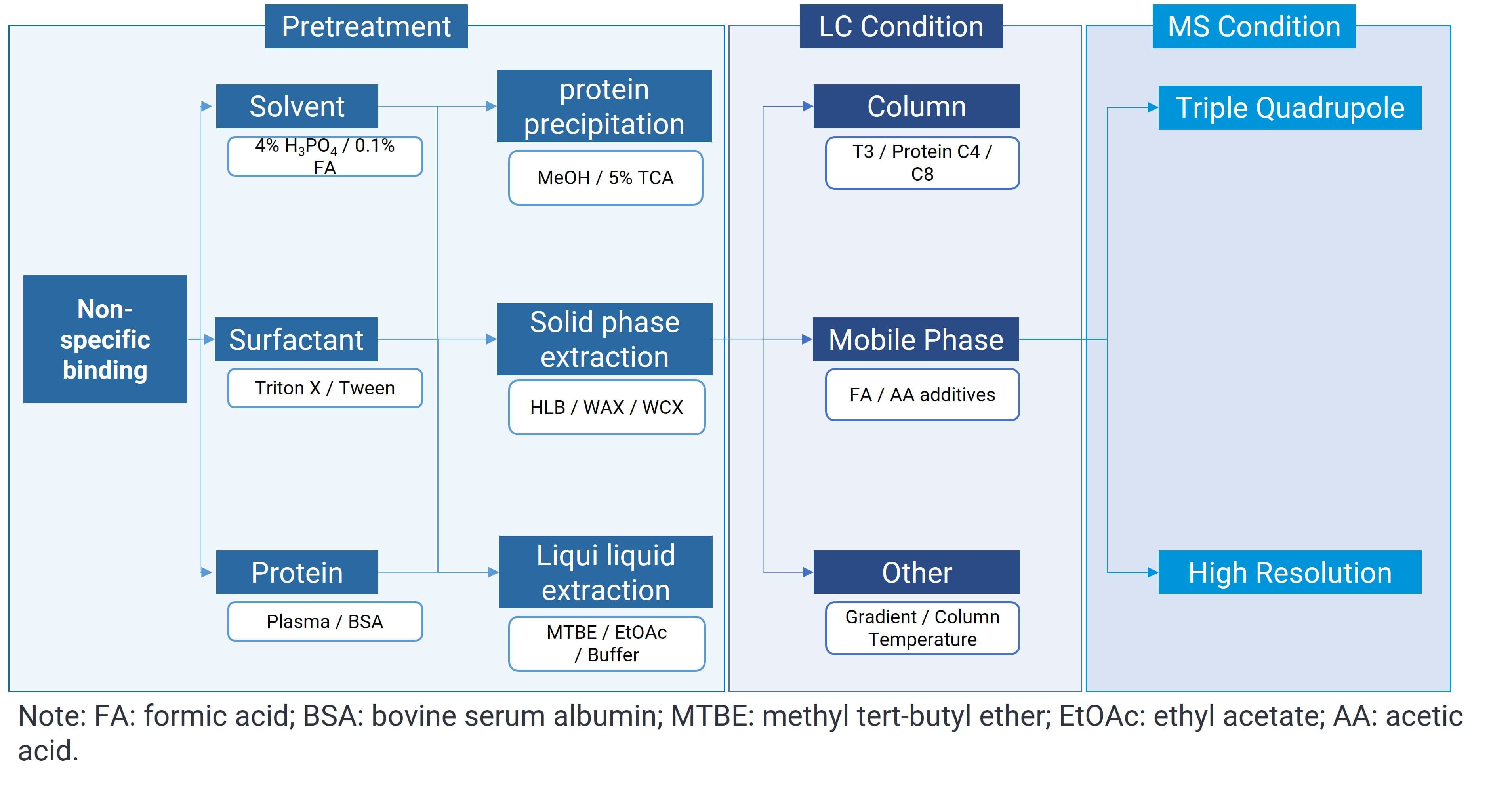
Figure 1. Workflow for LC-MS/MS analysis of conventional peptide drugs
Case Study: How to Optimize Peptide Analysis Using LC-MS/MS
Case 1: LC-MS/MS analysis of exenatide
Exenatide, a synthetic analog of the glucagon-like peptide-1 (GLP-1) exendin-4, is comprised of 39 amino acids and is primarily used for the treatment of type 2 diabetes. We've established a bioanalytical method for exenatide with an LLOQ of 41.8 pg/mL (Figure 2). As shown in Table 2, our results are comparable to those achieved with radioimmunoassay (RIA).
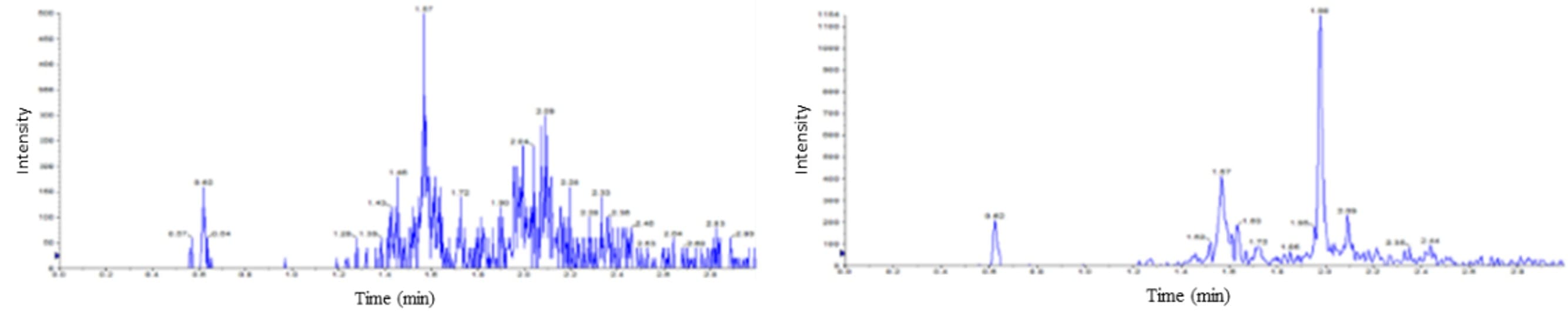
Figure 2. (A) LC-MS/MS chromatogram of blank sample (B) LC-MS/MS chromatogram of LLOQ (41.8 pg/mL) [5]
Table 2. Comparison of exenatide analysis methods
Category | Literature 1 [3] | Literature 2 [4] | WuXi AppTec DMPK |
Analysis method | RIA | LC-MS/MS | LC-MS/MS |
LLOQ | 25 pg/mL | 10 ng/mL | 41.8 pg/mL |
Sample preparation | Solid-phase extraction | Solid-phase extraction | Solid-phase extraction |
Summary
The pharmacokinetic characteristics of peptides are closely related to their physicochemical properties, chemical modifications, drug delivery systems, and properties of the conjugated drugs. Good bioanalytical methods are crucial for studying the peptide pharmacokinetics. This section summarizes the challenges and solutions in peptide bioanalysis based on LC-MS/MS technology, which can better utilize LC-MS/MS technology to provide accurate results rapidly for peptide analysis, thereby enhancing peptide pharmacokinetics research.
Authors: Yanfeng Liu, Weimin Hu, Weiqun Cao, Lili Xing
Talk to a WuXi AppTec expert today to get the support you need to achieve your drug development goals.
Committed to accelerating drug discovery and development, we offer a full range of discovery screening, preclinical development, clinical drug metabolism, and pharmacokinetic (DMPK) platforms and services. With research facilities in the United States (New Jersey) and China (Shanghai, Suzhou, Nanjing, and Nantong), 1,000+ scientists, and over fifteen years of experience in Investigational New Drug (IND) application, our DMPK team at WuXi AppTec are serving 1,600+ global clients, and have successfully supported 1,800+ IND applications.
Reference
[1] Markus, M., Glenn, F.K., David, J.A. et al., (2021). Trends in peptide drug discovery. Nature Reviews. 20: 309-325.
[2] Londhe, V. and Rajadhyaksha, M. (2019). Review of recommendations for bioanalytical method validation: chromatographic assays and ligand binding assays. Chromatographia 82: 523-535. http://doi.org/10.1007/s10337-018-3677-z.
[3] Ai, G., Zhen, Z., Shan, C. et al. (2008). Single- and multiple-dose pharmacokinetics of exendin-4 in rhesus monkeys. International Journal of Pharmaceutics 353: 56-64.
[4] Kehler, J.R., Bowen, C.L., Boram, S.L. et al. (2010). Application of DBS for quantitative assessment of the peptide Exendin-4; comparison of plasma and DBS method by UHPLC-MS/MS. Bioanalysis 2: 1461-1468.
[5] Liang Shen, editor. Drug Metabolism and Pharmacokinetics: Frontiers, Strategies, and Applications. Wiley. 2025. http://doi.org/10.1002/9781394300150.


Related Services and Platforms


-
 DMPK BioanalysisLearn More
-
Novel Drug Modalities DMPK Enabling PlatformsLearn More
-
Novel Drug Modalities BioanalysisLearn More
-
Small Molecules BioanalysisLearn More
-
Bioanalytical Instrument PlatformLearn More
-
PROTAC DMPK ServicesLearn More
-
ADC DMPK ServicesLearn More
-
Antibody-Oligonucleotide Conjugate (AOC) DMPK ServicesLearn More
-
Oligo DMPK ServicesLearn More
-
PDC DMPK ServicesLearn More
-
Peptide DMPK ServicesLearn More
-
mRNA DMPK ServicesLearn More
-
Covalent Drugs DMPK ServicesLearn More
Stay Connected
Keep up with the latest news and insights.

