



ADC Biotransformation: Study Models and LC-HRMS Method for Payload-Related Metabolite Identification
-

Articles
-

Aug 20, 2026
ADC drugs can be divided into cleavable and non-cleavable types. Cleavable ADCs will release toxin molecules by the hydrolysis of the ADC linker, while non-cleavable ADCs will release toxin molecules through the degradation of the antibody part. As the main components with pharmacological activity, the relevant structures of toxin molecules (payload-related metabolites) released by ADC should be determined as early as possible. These compounds are also the object of subsequent ADME studies, and their concentrations need to be simultaneously detected in ADC pharmacokinetics (PK) or toxicokinetics (TK) studies.
What Are the In Vitro and In Vivo Study Models for ADC Pharmacokinetics
A variety of study models are available to investigate the payload-release of ADC drugs. According to the mechanism of action of ADC drugs, liver lysosome and liver S9 can be selected to study the release of payload-related metabolites and the tumor cells incubation system can be used as a pharmacodynamic model to clarify the effective substances. After the major payload-related metabolites are determined, studies of the metabolic pathways of the small molecules can be conducted using hepatocytes, liver microsomes, or liver S9, and species differences can be compared to provide a basis for the selection of toxicological species. The metabolic study of ADC in vivo mainly focuses on the identification of payload-related metabolites in plasma, which can verify the stability of ADC drugs in systemic circulation [1] (Figure 1). Radiolabeled ADCs can be used to study tissue distribution in tumor-bearing mice to assess the extent of ADC enrichment in target tissues.
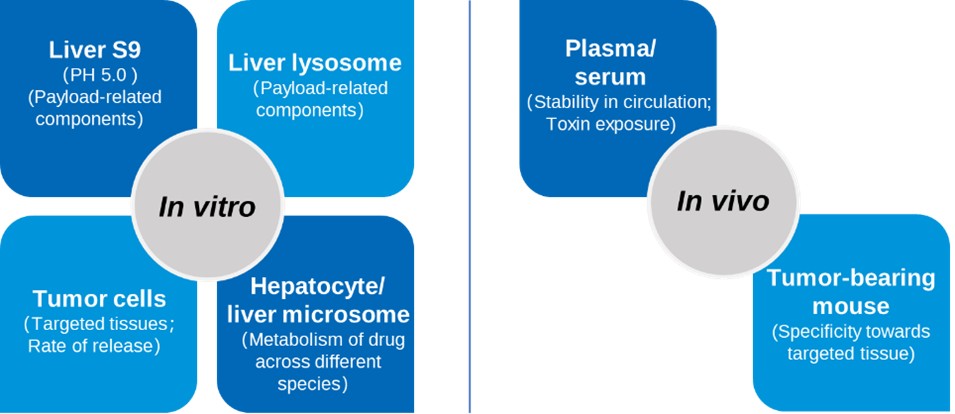
Figure 1. ADC Drug Metabolism Study Strategy [2]
How to Perform ADC Biotransformation Using LC-HRMS Technology
There are many challenges in the detection of payload-related metabolites due to the low concentrations released from ADCs and the difficulty in predicting the released products of non-cleavable ADCs. To this end, a liquid chromatography-high resolution mass spectrometry (LC-HRMS) method was established for the discovery and identification of payload-related metabolites released by ADC drugs. This method uses both targeted and non-targeted analytical techniques in data processing to quickly and comprehensively discover payload-related metabolites with unknown conjugation sites or connected with unknown amino acid sequences (Figure 2 and 3).
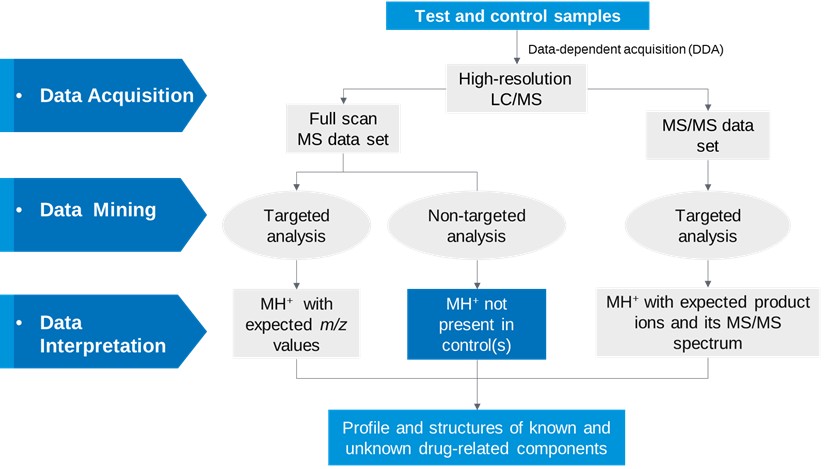
Figure 2. LC-HRMS Method for ADC Metabolites
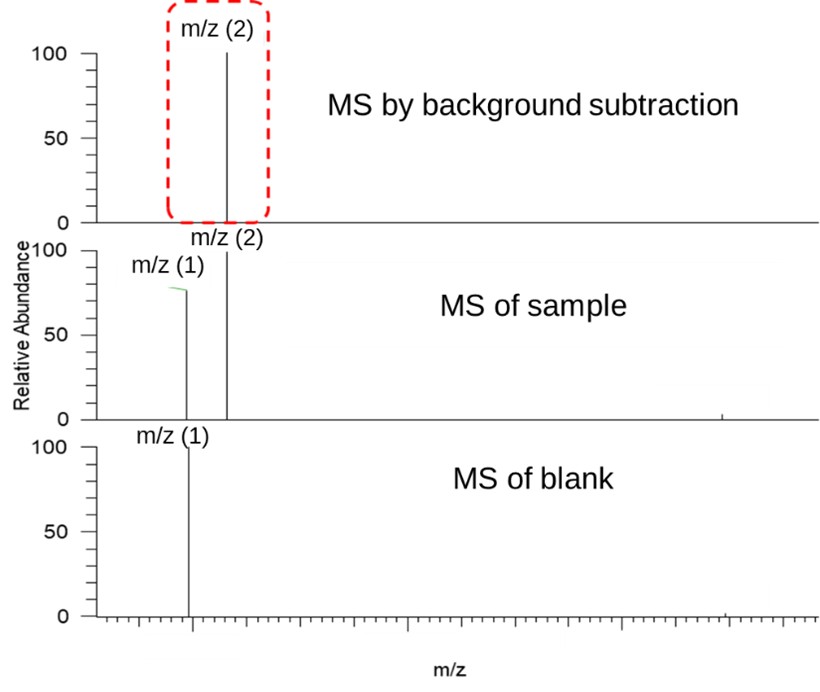
Figure 3. LC-HRMS after background subtraction
LC-HRMS can accurately distinguish the metabolite signals from the background signals within several mDa mass tolerance. The use of background subtraction technology can highlight the mass spectrum signals of the products from complex background signals, which is a typical non-targeted data analysis technology.
Case Studies: Identifying ADC Payload Metabolites via LC-HRMS
Case 1: Non-targeted high-resolution mass spectrometry method for finding payload-related metabolites released by ADCs in vitro lysosomes
A schematic of the structure of ADC-1 is shown in Figure 4.
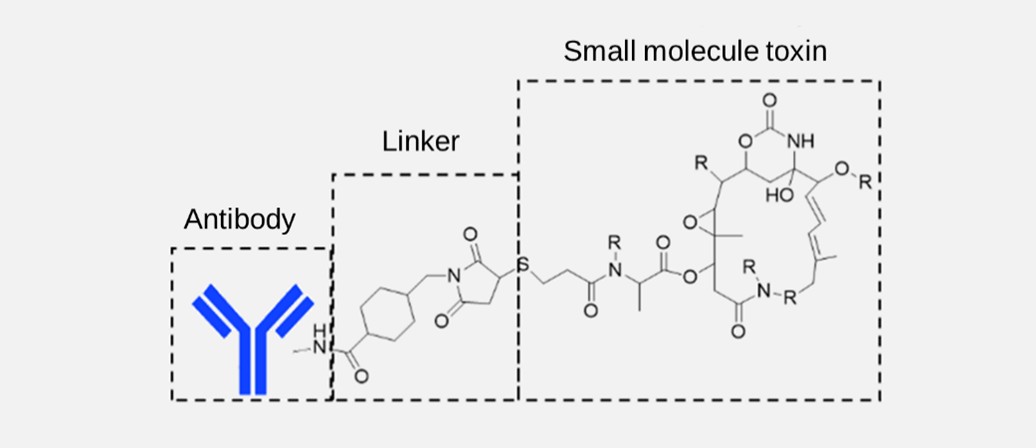
Figure 4. Structural diagram of ADC-1
ADC-1 was a non-cleavable ADC, in which the payload is coupled to the antibody on the lysine residues of the antibody through a linker. ADC-1 and the corresponding antibody were incubated in an acidic human lysosomal incubation system for 48 h. Primary and secondary MS data were collected by a high-resolution mass spectrometer. After incubation of ADC-1 in acidified lysosomes, liquid chromatography-ultraviolet (LC-UV), LC-HRMS, and background subtracted sample chromatograms were obtained as shown in Figure 5.
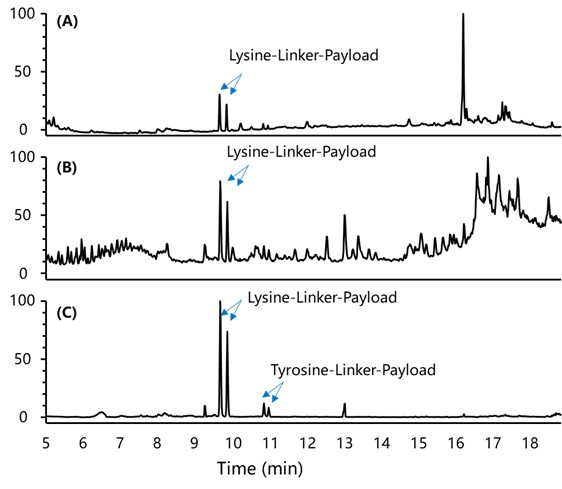
Figure 5. LC-UV (A), LC-MS/MS (B), and background-subtracted LC-MS/MS (C) of ADC-1 after acidified lysosomal incubation
The major degradation product released by ADC-1 shown in Figure 5 is lysine residue-linker-payload, which is consistent with the results reported in the literature and confirms the reliability of the in vitro metabolic system and detection method. In addition to major degradation products, minor metabolites with unknown amino acid sequences can also be observed after processing by background subtraction method, indicating that untargeted data processing technology can help discover unknown degradation products.
Case 2: High-resolution mass spectrometry analysis of small molecules released by ADC-2 in acidified liver S9
The structural diagram of ADC-2 is shown in Figure 6.
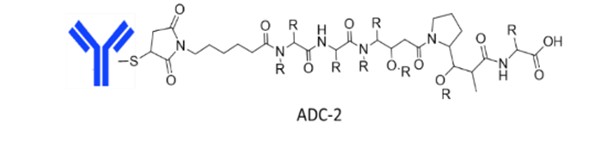
Figure 6. Structural diagram of ADC-2
We applied the established assay to analyze the unknown drug ADC-2, which consists of a known payload and new antibodies. ADC-2 was incubated with liver S9 for 48 h. After that, full scan chromatography was performed by LC-HRMS (Figure 7A). However, due to the low concentrations of small molecules released from ADC-2, which were more severely interfered with by the matrix, panel A did not show small molecules. Background subtraction data processing effectively removed the matrix interference signal and obtained full scan LC-HRMS chromatograms (Figure 7B) displaying Cys-mc-MMAF. It is the main degradation product. According to the parent ion of Cys-mc-MMAF, we obtained the LC-HRMS spectrum of Cys-mc-MMAF in the MS/MS data, which confirmed the structure of Cys-mc-MMAF and identified the site connecting the linker-payload in ADC-2 and the release mechanism.
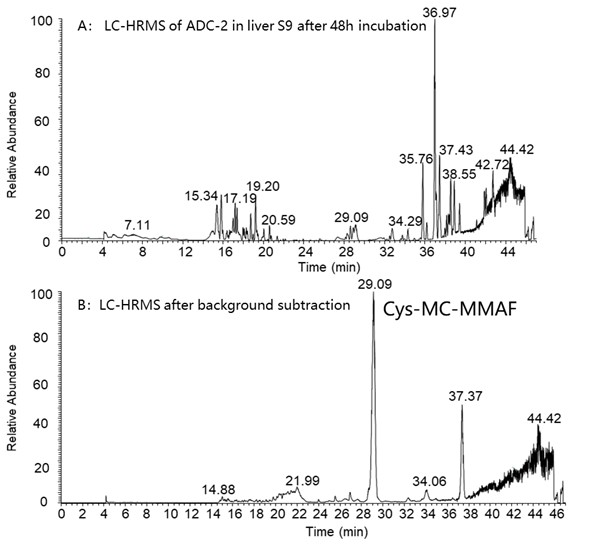
Figure 7. LC-HRMS (A) and LC-HRMS with background subtraction (B) after ADC-2 incubation in liver S9
Conclusion
These two examples using non-targeted high-resolution mass spectrometry to search for and identify payload-related metabolites in ADC incubation with liver lysosomes and S9 in vitro illustrate that liver lysosomes and S9 are effective in vitro metabolic models to study the release of toxin molecules by ADC; Furthermore, non-targeted high-resolution mass spectrometry is an effective method to discover and identify unknown payload-related metabolites released by ADCs.
Authors: Liqi Shi, Weiqun Cao
Talk to a WuXi AppTec expert today to get the support you need to achieve your drug development goals.
Committed to accelerating drug discovery and development, we offer a full range of discovery screening, preclinical development, clinical drug metabolism, and pharmacokinetic (DMPK) platforms and services. With research facilities in the United States (New Jersey) and China (Shanghai, Suzhou, Nanjing, and Nantong), 1,000+ scientists, and over fifteen years of experience in Investigational New Drug (IND) application, our DMPK team at WuXi AppTec are serving 1,600+ global clients, and have successfully supported 1,800+ IND applications.
Reference
[1] Tingting Cai, Liqi Shi, Huihui Guo, Ruixing Li, Weiqun Cao, Liang Shen, Mingshe Zhu, Yi Tao, Detection and Characterization of In Vitro Payload-Containing Catabolites of Noncleavable Antibody-Drug Conjugates by High-Resolution Mass Spectrometry and Multiple Data Mining Tools, Drug Metabolism and Disposition, Volume 51, Issue 5, 2023, Pages 591-598.
[2] Liang Shen, editor. Drug Metabolism and Pharmacokinetics: Frontiers, Strategies, and Applications. Wiley. 2025. http://doi.org/10.1002/9781394300150.


Related Services and Platforms


-
 DMPK BioanalysisLearn More
-
Novel Drug Modalities DMPK Enabling PlatformsLearn More
-
Novel Drug Modalities BioanalysisLearn More
-
Small Molecules BioanalysisLearn More
-
Bioanalytical Instrument PlatformLearn More
-
PROTAC DMPK ServicesLearn More
-
ADC DMPK ServicesLearn More
-
Antibody-Oligonucleotide Conjugate (AOC) DMPK ServicesLearn More
-
Oligo DMPK ServicesLearn More
-
PDC DMPK ServicesLearn More
-
Peptide DMPK ServicesLearn More
-
mRNA DMPK ServicesLearn More
-
Covalent Drugs DMPK ServicesLearn More
Stay Connected
Keep up with the latest news and insights.

