




Conferences
ISSX: 27th North American Meeting | Back to the Future: DMPK Foundations and New Concepts
-

October 11 – 14, 2026
-

San Francisco, California, US


The 27th North American ISSX Meeting, Back to the Future: DMPK Foundations and New Concepts, will examine how core DMPK principles continue to inform—and evolve alongside—emerging scientific approaches in drug discovery and development.
The scientific program spans artificial intelligence and machine learning in ADME research, advances in drug–drug interaction assessment, mechanistic and systems pharmacology modeling, and real-world case studies highlighting unexpected biotransformations. Additional sessions explore innovative strategies for treating neurodegenerative diseases, pharmacogenetic drivers of drug toxicity, long-acting medicines, structure-based ADME, and the evolving landscape of obesity therapeutics.
Complementing the symposia, in-depth short courses will address microphysiological systems, in vitro–in vivo extrapolation, DMPK characterization of biologics, and emerging insights into extrahepatic metabolism, offering attendees both foundational knowledge and forward-looking perspectives on the future of DMPK.
Our posters
Other Resources
-
 Our posters
 -
Other Resources
-
-
Vehicle Screening and Optimization to Improve Oral Bioavailability of PROTAC Drugs
Throughout preclinical formulation development of PROTACs and similar poorly soluble drugs, it is crucial to improve the solubilizing capacity of vehicles and effectively maintain supersaturation. This can effectively support the exposure assessment of these drugs in preclinical in vivo studies.
Get the PDF via email when it's ready. Leave your email address below.
WuXi AppTec requires your contact information to share our updates. Please review our privacy policy here. You can unsubscribe at any time.

-
Screening Strategies for Cyclic Peptide Drugs Based on Structural Characteristics and In Vivo Pharmacokinetics Validation
In this experiment, octreotide was used as the test compound. The mechanism of its metabolism in intestinal fluid was evaluated through in vitro simulated intestinal fluid stability studies, and the effect of vehicles containing different permeation enhancers on the bioavailability of the test compound was verified in vivo using a rat duodenal animal model. The experimental results indicate that the degradation of octreotide in intestinal fluid exhibits significant pancreatin dependence.
Get the PDF via email when it's ready. Leave your email address below.
WuXi AppTec requires your contact information to share our updates. Please review our privacy policy here. You can unsubscribe at any time.
-
ChromLog D: A Rapid Reversed-Phase LC Method for Lipophilicity Estimation of Neutral, Ionizable, and Complex Compounds in High-Throughput Screening
The ChromLog D approach provides a practical balance between throughput and quantitative performance for lipophilicity assessment. It is particularly advantageous for ionizable, complex, and adsorption-prone compounds that are difficult to evaluate using conventional approaches. In practice, direct logk′ measurement can be used for rapid compound ranking and prioritization, while calibrated ChromLog D offers improved quantitative estimation. This dual capability makes ChromLog D a useful and flexible tool for early-stage drug discovery and high-throughput profiling of emerging chemical modalities.
Get the PDF via email when it's ready. Leave your email address below.
WuXi AppTec requires your contact information to share our updates. Please review our privacy policy here. You can unsubscribe at any time.
-
Rapid Mapping of Disulfide Bonds in Complex Cyclic Peptides via a Sequence-Tailored Enzymatic Digestion and LC-HRMS Workflow
Disulfide bonds play a pivotal role in stabilizing the conformation and ensuring the therapeutic efficacy of complex cyclic peptides. Conventional characterization strategies—including partial reduction/alkylation, chemical derivatization, exhaustive synthesis, and surface plasmon resonance (SPR) verification—are highly tedious, low-throughput, and resource-intensive. To overcome these bottlenecks, this study established a comprehensive workflow integrating a sequence-dependent enzymatic digestion strategy with liquid chromatography-high resolution mass spectrometry (LC-HRMS) and innovative software to rapidly map disulfide bonds.
Get the PDF via email when it's ready. Leave your email address below.
WuXi AppTec requires your contact information to share our updates. Please review our privacy policy here. You can unsubscribe at any time.
-
Oligo MetID: An Integrated LC-HRMS Workflow for In Vitro Metabolite Identification of Therapeutic Oligonucleotides Using Inclisiran as a Model Compound
The proposed Oligo MetID workflow enabled systematic detection and annotation of inclisiran metabolites while simplifying data processing and interpretation. The observed metabolic profile was consistent with the established nuclease-mediated degradation pathways of chemically modified siRNAs, supporting the utility of the workflow for preclinical metabolism studies and the characterization of therapeutic oligonucleotides.
Get the PDF via email when it's ready. Leave your email address below.
WuXi AppTec requires your contact information to share our updates. Please review our privacy policy here. You can unsubscribe at any time.
-
In Vitro Investigation of Drug-Induced Liver Injury Using Radiolabeled Compounds
The CVB Burden and CVB values obtained from in vitro incubations, along with comparison to the positive control [14C]Clozapine, indicated that [14C]LS002 exhibited a high-level of covalent binding in the liver and suggested a potential risk of liver injury in clinical use. The result demonstrated that we have established a method using radiolabeled compounds to evaluate covalent binding levels after in vitro incubation. This method can indicate DILI risk, supporting both early drug screening and clinical risk assessment.
Get the PDF via email when it's ready. Leave your email address below.
WuXi AppTec requires your contact information to share our updates. Please review our privacy policy here. You can unsubscribe at any time.
-
High Throughput LC-MS/MS Methods for Determination of Metabolites from Eight Key Probe Substrates in CYP Time-dependent Inhibition Assays
The ADDA-LC-MS/MS employed multiplexed LC technology, achieving two‑fold faster sample throughput versus conventional LC without compromising chromatographic separation. Excellent linearity was observed over the validated concentration ranges (r > 0.99 for all metabolites). Intra‑day accuracy was within ±20% (mean accuracy 80–120%) and precision (RSD) was ≤25%.
Get the PDF via email when it's ready. Leave your email address below.
WuXi AppTec requires your contact information to share our updates. Please review our privacy policy here. You can unsubscribe at any time.
-
Establishment of MDCK II-based In Vitro Models for Screening Human and Rat BCRP Substrates and Inhibitors
The newly established hBCRP/rBcrp-MDCK II cell models provide a validated and reproducible platform for screening potential human BCRP and rat Bcrp substrates and inhibitors, enabling the comparison of species-specific transport activity and supporting the interpretation of preclinical pharmacokinetic data for translational applications.
Get the PDF via email when it's ready. Leave your email address below.
WuXi AppTec requires your contact information to share our updates. Please review our privacy policy here. You can unsubscribe at any time.
-
Development of a Quantitative LC-MS/MS-based Phenylalanine Hydroxylase Activity Assay for Evaluation of PAH-directed Therapies
Deficiency of PAH results in phenylketonuria (PKU), an inherited metabolic disorder characterized by elevated phenylalanine concentrations and progressive neurological impairment if untreated. Accurate measurement of hepatic PAH activity is essential for evaluating enzyme replacement and gene therapies. However, existing assays are indirect or require extensive sample preparation because of interference from endogenous tyrosine. This study aimed to develop a direct LC-MS/MS assay that quantifies tyrosine generated during an in vitro enzymatic reaction as a robust and quantitative measure of PAH activity in liver tissue.
Get the PDF via email when it's ready. Leave your email address below.
WuXi AppTec requires your contact information to share our updates. Please review our privacy policy here. You can unsubscribe at any time.
-
Application of Multiple Fragmentation Modes for Metabolite Characterization: Exploring Orbitrap HCD, ZenoTOF CID, and Expanded EAD
Structural elucidation of complex modalities (e.g., PROTACs) and labile metabolites (e.g., acyl glucuronides) remains a significant challenge in drug metabolism and pharmacokinetics (DMPK). Traditional collision-induced dissociation (CID) and higher-energy collisional dissociation (HCD) often struggle with large multifaceted molecules and lead to the neutral loss of labile moieties, complicating the precise localization of metabolism sites. This study explores the integrated application of conventional fragmentation methods and the expanded electron activated dissociation (EAD) technology on the new ZenoTOF 8600 system, aiming to establish a robust and complementary workflow for metabolite identification (MetID).
Get the PDF via email when it's ready. Leave your email address below.
WuXi AppTec requires your contact information to share our updates. Please review our privacy policy here. You can unsubscribe at any time.
-
Application of a Rapid Inhibitor-based Human Hepatocyte Screening Assays for Early Identification of Metabolic Pathways
Human hepatocytes represent the optimal in vitro metabolism model as they express the comprehensive complement of drug-metabolizing enzymes. However, identifying the specific enzyme(s) driving the clearance of a drug candidate within this complex system remains challenging. Elucidating these pathways early in the lead optimization phase is crucial for predicting human clearance and mitigating drug-drug interaction (DDI) risks.
Get the PDF via email when it's ready. Leave your email address below.
WuXi AppTec requires your contact information to share our updates. Please review our privacy policy here. You can unsubscribe at any time.
-
An Integrated In Vitro DMPK Evaluation Strategy for Preclinical ADC Assessment
Linker and payload properties determine ADC in vivo efficacy and off-target toxicity; a unified multi-dimensional in vitro DMPK platform can characterize ADC circulatory safety and payload release responsive to intended triggers (e.g., tumor microenvironment, cellular internalization, enzymatic cleavage) to predict druggability at early stages and reduce in vivo research failure risks.
Get the PDF via email when it's ready. Leave your email address below.
WuXi AppTec requires your contact information to share our updates. Please review our privacy policy here. You can unsubscribe at any time.
-
A Method for Evaluating Formulation Stability of Amorphous Solid Dispersions (ASDs) in Preclinical Studies
To obtain a stable formulation and reproducible data of ASDs, we recommend conducting stability studies including solubility, particle size and crystal form, before the preparation of preclinical formulations, and ensuring that all operating procedures are clearly defined and strictly followed during formulation preparation.
Get the PDF via email when it's ready. Leave your email address below.
WuXi AppTec requires your contact information to share our updates. Please review our privacy policy here. You can unsubscribe at any time.
-
Canine Segmental Intestinal Cannulation Model for Assessing Peptide Absorption: Validation and Application of a Duodenal Cannulation Model Using Octreotide
Oral peptide drug absorption is limited by the triple barrier of gastric degradation, intestinal enzymatic hydrolysis, and poor permeability. Conventional models fail to distinguish absorption contributions from different intestinal segments, thereby falling to pinpoint the rate‑limiting sites. Dogs are the preferred model for studying intestinal peptide absorption due to their high similarity to humans in gastrointestinal anatomy, pH gradient, and enzyme profiles. In this study, we established and validated a canine duodenal cannulation model to enables direct perfusion of a specific intestinal segment, bypassing gastric interference and accurately quantifying the segment's intrinsic absorptive capacity.
Get the PDF via email when it's ready. Leave your email address below.
WuXi AppTec requires your contact information to share our updates. Please review our privacy policy here. You can unsubscribe at any time.
-
The Application of Non-Human Primate Liver Biopsy Technique in Preclinical Pharmacokinetic Studies of Oligonucleotide Therapies
Liver-targeted oligonucleotide therapy requires direct quantification of hepatic drug exposure, yet conventional terminal sampling precludes longitudinal monitoring and consumes large numbers of animals. We developed an ultrasound‑guided percutaneous repeat liver biopsy technique in cynomolgus monkeys that enables repeated tissue collection from the same individual over extended periods.
Get the PDF via email when it's ready. Leave your email address below.
WuXi AppTec requires your contact information to share our updates. Please review our privacy policy here. You can unsubscribe at any time.
-
X-ray/CT Dynamic Tracking Technology: An In Vivo Visualization Solution for Oral Peptide Drugs——Supporting Formulation Development and Large Animal PK Studies
This study established a novel tracer technology based on image assistance: oral preparations were made by mixing peptide drugs with medical barium sulfate in a certain proportion. With the help of two-dimensional real-time dynamic imaging of X-rays and three-dimensional high-resolution tomography of CT, the real-time position, movement trajectory and disintegration and dispersion process of barium sulfate were tracked, and the spatiotemporal distribution characteristics of the drug in each segment such as the stomach, duodenum, jejunum, ileum and colon were indirectly inferred.
Get the PDF via email when it's ready. Leave your email address below.
WuXi AppTec requires your contact information to share our updates. Please review our privacy policy here. You can unsubscribe at any time.
-
A Comparative Study on Cerebrospinal Fluid Blood Contamination Assessment Methods: From Visual Screening to Precise Quantification
Cerebrospinal fluid (CSF) drug concentration is a core metric for evaluating central nervous system drug exposure and blood–brain barrier (BBB) permeability (Kp,uu). However, since large molecule drugs exhibit extremely low BBB permeability, a substantial concentration gradient between blood and CSF is formed, and even minor blood contamination can severely skew the data. Therefore, assessment and correction of CSF sample contamination are critical. This study systematically compared the performance of three blood contamination detection methods: visual inspection, ultraviolet spectrophotometry, and lactate dehydrogenase (LDH) enzymatic method.
Get the PDF via email when it's ready. Leave your email address below.
WuXi AppTec requires your contact information to share our updates. Please review our privacy policy here. You can unsubscribe at any time.
-
Human Hepatocyte-Based CYP Inhibition Assays to Enhance Prediction of CYP Inhibition for Peptides and siRNA molecules
Cytochrome P450 (CYP) inhibition studies are routinely conducted in human liver microsomes (HLM). However, microsomal systems may overexpose CYP enzymes to test articles, especially high-molecular-weight drug candidates, due to limited membrane permeability, potentially increasing the risk of overestimating CYP inhibition. Therefore, an in vitro assay using human hepatocytes was established to provide more physiologically relevant conditions for CYP inhibition assessment.
Get the PDF via email when it's ready. Leave your email address below.
WuXi AppTec requires your contact information to share our updates. Please review our privacy policy here. You can unsubscribe at any time.
-
Assessment of Tween 80 Safety Limits in Beagle Dogs and Cynomolgus Monkeys for Injectable Formulations
Polysorbates, such as Tween 80, are valuable solubilisers used in injectable formulations. They assist in dissolving hydrophobic drugs, stabilising protein-based drugs, improving the uniformity and stability of formulations, and reducing surface tension to prevent active ingredients from adhering to containers. However, there have been some reports of low blood pressure and severe allergic reactions following intravenous (IV) administration in dogs, with unclear details regarding doses and safety limits. This study aims to determine safe concentration and volume limits for Tween 80 in Beagle dogs (via IV and SC routes) and to compare tolerance profiles with cynomolgus monkeys (via IV).
Get the PDF via email when it's ready. Leave your email address below.
WuXi AppTec requires your contact information to share our updates. Please review our privacy policy here. You can unsubscribe at any time.
View More -
-
-

Decoding Peptide Metabolism: The Role of Peptide Enzymes and Peptide Optimization Strategies
 ArticlesJul 23,2026
-
A Comprehensive Guide to Tissue Homogenization Quality Control in DMPK Studies: From Method Selection to Data Reliability
ArticlesJul 17,2026 -
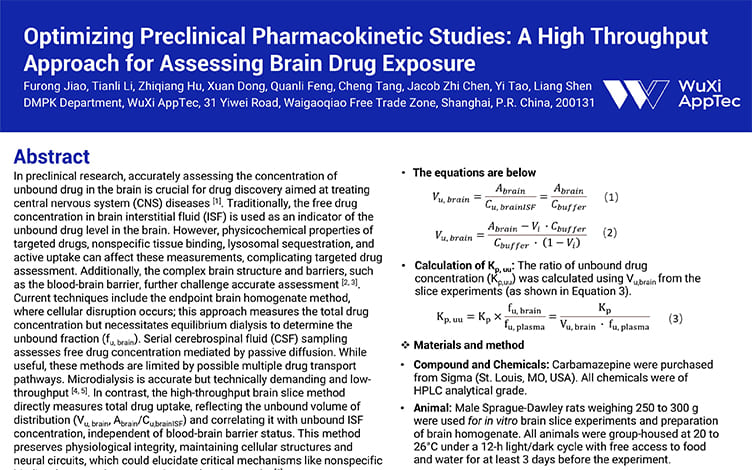
Optimizing Preclinical Pharmacokinetic Studies: A High Throughput Approach for Assessing Brain Drug Exposure
PostersJul 10,2026
-



Related Services and Platforms


-
 In Vitro ADME ServicesLearn More
 -
In Vivo PharmacokineticsLearn More
-
MetID (Metabolite Profiling and Identification)Learn More
-
Radiolabeled In Vivo ADME StudyLearn More
-
DMPK BioanalysisLearn More
-
Physicochemical Property StudyLearn More
-
Permeability and Transporter StudyLearn More
-
Drug Distribution and Protein Binding StudiesLearn More
-
Metabolic Stability StudyLearn More
-
Drug Interactions StudyLearn More
-
Rodent PK StudyLearn More
-
Large Animal (Non-Rodent) PK StudyLearn More
-
Clinicopathological Testing Services for Laboratory AnimalsLearn More
-
High-Standard Animal Facilities and Animal WelfareLearn More
-
Preclinical Formulation ScreeningLearn More
-
In Vitro MetID (Metabolite Profiling and Identification)Learn More
-
In Vivo MetID (Metabolite Profiling and Identification)Learn More
-
Metabolite Biosynthesis and Structural CharacterizationLearn More
-
Metabolites in Safety Testing (MIST)Learn More
-
Radiolabeled MetID (Metabolite Profiling and Identification)Learn More
-
Radiolabeled Non-Clinical In Vivo ADME StudyLearn More
-
Quantitative Whole-body Autoradiography (QWBA)Learn More
-
Human Radiolabeled Mass Balance StudyLearn More
-
Radiolabeled Compound SynthesisLearn More
-
Novel Drug Modalities BioanalysisLearn More
-
Small Molecules BioanalysisLearn More
-
Bioanalytical Instrument PlatformLearn More



















Stay Connected
Keep up with the latest news and insights.
Submission successful!
We will send you an email with all the posters from this conference once they are ready. Thank you!
-
ok


