



Bioanalysis Publication: An Ultra-Sensitive UPLC-MS Method for ADC Payload Analysis Developed by WuXi AppTec DMPK
-

Articles
-

May 14, 2026
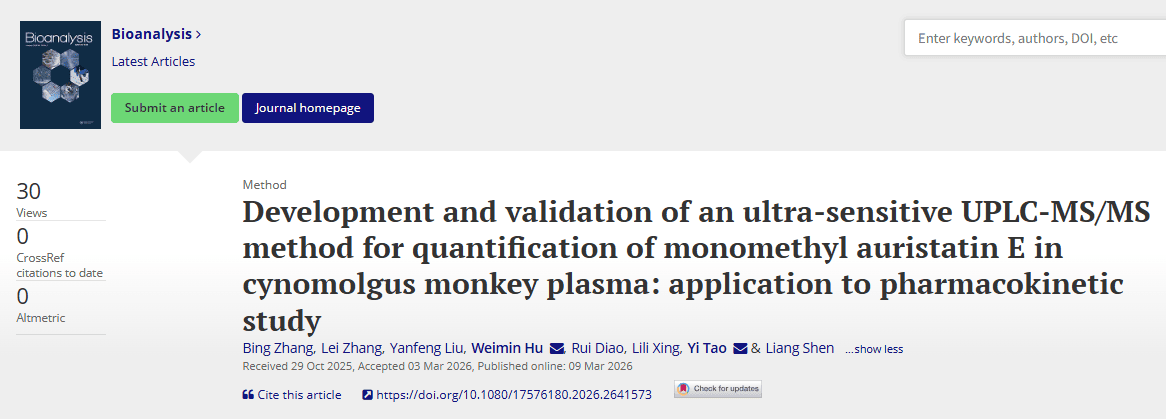
On March 9, WuXi AppTec DMPK published a study in the journal Bioanalysis titled "Development and validation of an ultra-sensitive UPLC-MS/MS method for quantification of monomethyl auristatin E in cynomolgus monkey plasma: application to pharmacokinetic study" (full text accessible at the end of this article). This study established an ultra-sensitive, high-throughput UPLC-MS/MS method for quantifying free MMAE ADC payload in cynomolgus monkey plasma, reducing the lower limit of quantification (LLOQ) to 5 pg/mL, with an analysis time of only 1.5 minutes per sample, and successfully applied it to pharmacokinetic (PK) studies of low-dose antibody-drug conjugates (ADCs). This article interprets the original study from three dimensions: the technical details of method development, indicators of the validation process, and performance in practical PK applications, providing a technical reference for ADC drug analysis.
Challenges in ADC Payload Analysis
MMAE (monomethyl auristatin E) is one of the most commonly used toxic payloads for ADCs, known for its potent cytotoxicity (IC50 as low as 10⁻¹¹–10⁻⁹ M). Consequently, ADCs are typically dosed at low levels in preclinical studies. After administration, the concentration of free MMAE in plasma often reaches trace levels. Conventional LC-MS/MS methods typically have LLOQs of 25-50 pg/mL, which results in many time points in low-dose PK studies falling below the detection limit, leading to incomplete concentration-time curves and preventing the calculation of key pharmacokinetic parameters. Currently, common sample preparation methods include protein precipitation (PPT), liquid-liquid extraction (LLE), and solid-phase extraction (SPE). While PPT is simple to perform, its sensitivity is limited. SPE can concentrate the target analyte, but it involves complex processes and higher costs. LLE achieves a better balance between enrichment efficiency and ease of operation. Previously reported LLE methods for cynomolgus monkey serum have an LLOQ of 25 pg/mL, while SPE methods for human plasma have an LLOQ of 50 pg/mL, both failing to meet the requirements for plotting complete PK curves after low-dose ADC administration. Additionally, the limited plasma sample volume available in preclinical studies imposes stricter demands on sample usage. Addressing these challenges, the current study sought to establish a more sensitive and practical UPLC-MS/MS method.
Establishing a High-Sensitivity, Miniaturized, High-Throughput ADC Payload Quantification Platform for MMAE
This study utilized cynomolgus monkey plasma as the matrix and developed a novel quantitative method based on LLE combined with UPLC-MS/MS through systematic optimization of sample preparation and chromatographic conditions.
Sample Preparation: By screening extraction solvents at different pH levels, it was found that ammonium carbonate buffer at pH 9.6 significantly improved the extraction efficiency of MMAE. Methyl tert-butyl ether (MTBE) was selected as the extraction solvent, yielding better results than ethyl acetate. Ultimately, only 40 μL of plasma (approximately 20%–50% of the usual amount) was required, and after LLE extraction and nitrogen blow-down concentration, the sample was re-dissolved in 0.1% formic acid in water for analysis.
Chromatographic Conditions: A CSH Fluoro-Phenyl column was employed, leveraging the π-π interactions between the phenyl ring of MMAE and the fluorophenyl stationary phase to improve peak shape. No ammonium formate was added to the mobile phase, reducing ion suppression and enhancing signal response by 30%–40%. The analysis time for a single sample was controlled at 1.5 minutes, significantly improving throughput.
The method validation strictly adhered to ICH M10 and FDA guidelines. Results showed that the method exhibited good linearity within the 5–3000 pg/mL range (r ≥ 0.996), with a signal-to-noise ratio (S/N) over 10 for the LLOQ, and good peak shapes. Accuracy across linear points ranged from 92.83% to 106.45%. Intra- and inter-batch precision (CV) for the LLOQ was ≤ 18.63%, while other quality control samples were ≤ 7.48%. Intra- and inter-batch accuracy ranged from 83.98% to 112.75%. Selectivity, carryover, matrix effect, dilution reliability, extraction recovery (81.42%–89.26%), and various stability tests (24 hours at room temperature, 5 freeze-thaw cycles, 7 days at -80°C, and 96 hours in an auto-sampler) were all validated.
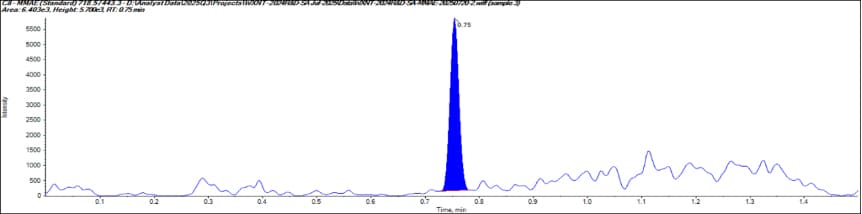
Figure 1. LC-MS/MS chromatogram of ADC payload MMAE at LLOQ (5 pg/mL) in cynomolgus monkey plasma
Table 1. Linearity validation of MMAE calibration curves in cynomolgus monkey plasma
Batch | MMAE Concentrations (pg/mL) | |||||||
5 | 10 | 50 | 100 | 250 | 500 | 1000 | 3000 | |
1 | 4.65 | 11.29 | 50.96 | 106.92 | 258.07 | 492.31 | 873.41 | 2,885.61 |
2 | 5.34 | 8.51 | 50.44 | 108.34 | 262.09 | 508.65 | 929.60 | 2,978.92 |
3 | 5.09 | 9.58 | 50.88 | 104.08 | 251.44 | 518.00 | 981.79 | 2,829.78 |
Mean | 5.03 | 9.79 | 50.76 | 106.45 | 257.20 | 506.32 | 928.27 | 2,898.10 |
%Nominal | 100.53 | 97.93 | 101.52 | 106.45 | 102.88 | 101.26 | 92.83 | 96.60 |
N | 3 | 3 | 3 | 3 | 3 | 3 | 3 | 3 |
Research Highlights and Application Value
In the preclinical development of ADC drugs, quantifying ADC free payloads has been a challenging aspect of PK studies — the low dosing results in trace plasma concentrations, and traditional methods often lack the sensitivity necessary to obtain complete concentration-time curves. The method established in this study represents a substantial breakthrough in addressing this issue.
In a PK study using a 0.5 mg/kg dose of ADC in cynomolgus monkeys, conventional LC-MS/MS methods (LLOQ = 50 pg/mL) could quantify MMAE concentrations at only two time points post-administration, with concentrations undetectable after 24 hours, thereby preventing calculations of terminal elimination half-life (T1/2) and the total area under the curve (AUC). Conversely, the optimized method (LLOQ = 5 pg/mL) successfully quantified MMAE concentrations at all six time points within 72 hours post-administration, achieving a complete elimination phase despite the low dosing. This advancement is significant because only with a complete PK curve can parameters such as half-life, clearance rate, and exposure be accurately calculated, establishing exposure-response relationships that are crucial for linking these parameters with subsequent toxicity observations or efficacy data. Such data provide vital evidence for advancing ADC molecules into the next phase of development.
From a methodological perspective, compared to previously reported MMAE ADC payload quantification methods, this study achieved a 5-200-fold increase in sensitivity, a 50%-80% reduction in sample volume, and a decrease in individual sample analysis time from the typical 3-12 minutes to just 1.5 minutes. The practical implications of these enhancements are multifaceted: for small animal models like mice, it allows for the collection of up to 7-8 time points from just 200 μL of whole blood, enabling complete PK curve mapping without needing to pool samples; for primate samples, the remaining plasma can be used for other tests or stored as backup, providing greater analytical flexibility in future studies. Overall, this method balances sensitivity, sample volume, and analytical throughput, better supporting preclinical PK studies of low-dose ADC administration.
Concluding Remarks
WuXi AppTec DMPK successfully combined optimized sample preparation with a high-sensitivity mass spectrometry platform to establish an ultra-sensitive, high-throughput quantification method for MMAE. This method allows for the complete mapping of the PK curve of free MMAE in cynomolgus monkeys after low-dose ADC administration, providing technical support for preclinical screening, toxicology studies, and clinical translation of ADC drugs.
For ADC drugs, WuXi AppTec DMPK offers differentiated quantitative ADC analysis services covering total antibodies, ADC conjugates, and free ADC payloads, equipped with multiple sensitive LC-MS/MS platforms and capabilities for radiolabeling and biomarker analysis, committed to accelerating the development process of innovative ADC drugs for clients.
Talk to a WuXi AppTec expert today to get the support you need to achieve your drug development goals.
Committed to accelerating drug discovery and development, we offer a full range of discovery screening, preclinical development, clinical drug metabolism, and pharmacokinetic (DMPK) platforms and services. With research facilities in the United States (New Jersey) and China (Shanghai, Suzhou, Nanjing, and Nantong), 1,000+ scientists, and over fifteen years of experience in Investigational New Drug (IND) application, our DMPK team at WuXi AppTec are serving 1,600+ global clients, and have successfully supported 1,800+ IND applications.


Related Services and Platforms


-
 DMPK BioanalysisLearn More
-
Novel Drug Modalities DMPK Enabling PlatformsLearn More
-
Novel Drug Modalities BioanalysisLearn More
-
Small Molecules BioanalysisLearn More
-
Bioanalytical Instrument PlatformLearn More
-
PROTAC DMPK ServicesLearn More
-
ADC DMPK ServicesLearn More
-
Antibody-Oligonucleotide Conjugate (AOC) DMPK ServicesLearn More
-
Oligo DMPK ServicesLearn More
-
PDC DMPK ServicesLearn More
-
Peptide DMPK ServicesLearn More
-
mRNA DMPK ServicesLearn More
-
Covalent Drugs DMPK ServicesLearn More

Stay Connected
Keep up with the latest news and insights.

